The Challenge
Binary classifications like “permanent” vs “nature-based” oversimplify carbon removal and are divisive.
They obscure how risks actually behave across time, limiting effective deployment and investment.
Our Approach
Carbon at Risk quantifies how carbon storage outcomes evolve over time, from best to worst case.
By modelling risk factors, correlations and timing of losses, it provides a more complete picture of carbon permanence.
Why it matters
Achieving net zero requires looking beyond how much carbon is stored, to how secure that storage is over time.
Better risk understanding supports better decisions, stronger carbon removal credibility and more resilient climate strategies.
Explore the Carbon Risk Tool
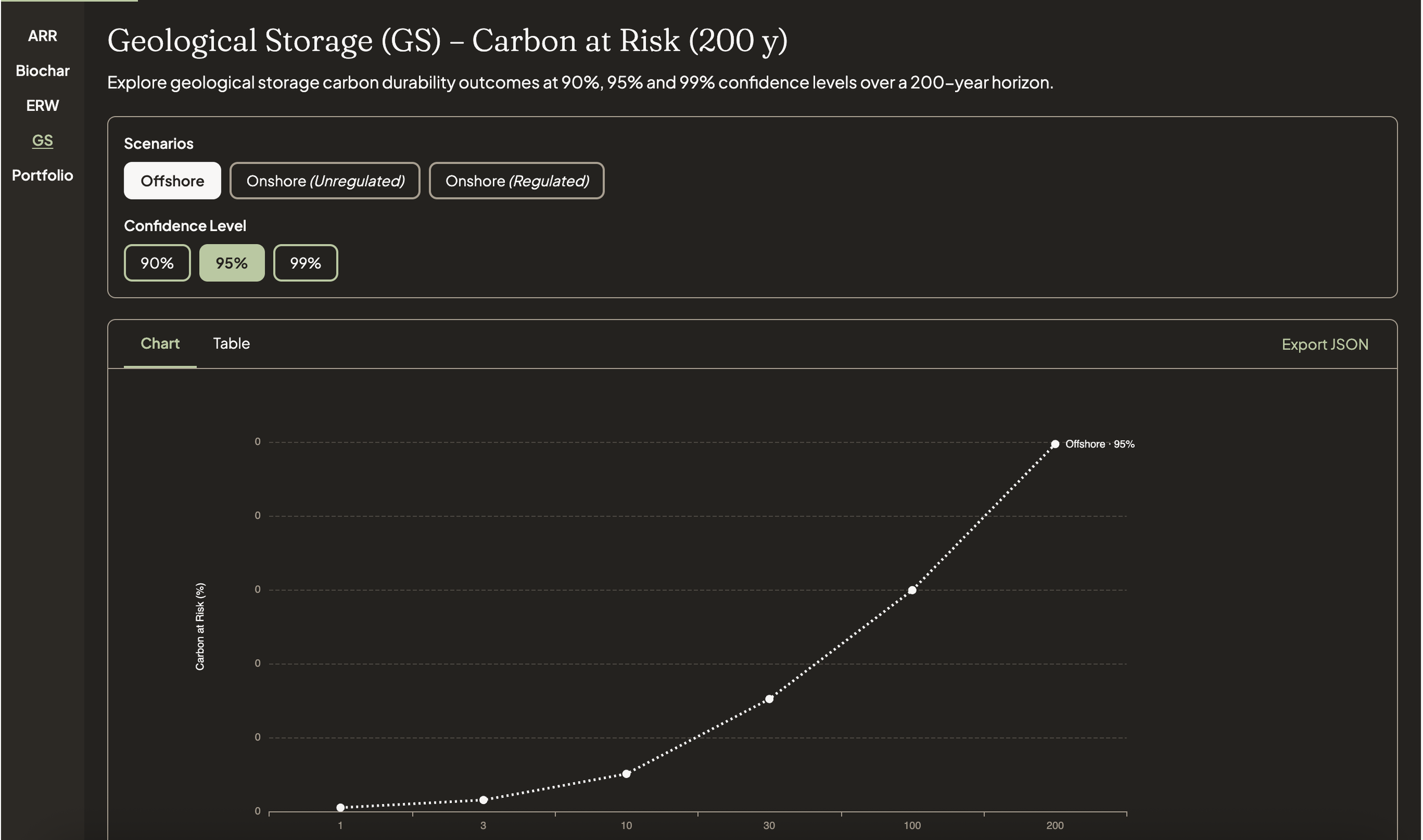
Carbon at Risk quantifies how carbon storage risk evolves over time, capturing not just expected losses, but their probability, magnitude and timing.
Moving beyond binary permanence classifications, it provides the foundation for better risk management, procurement and policy across all removal pathways.
Research & Methodology
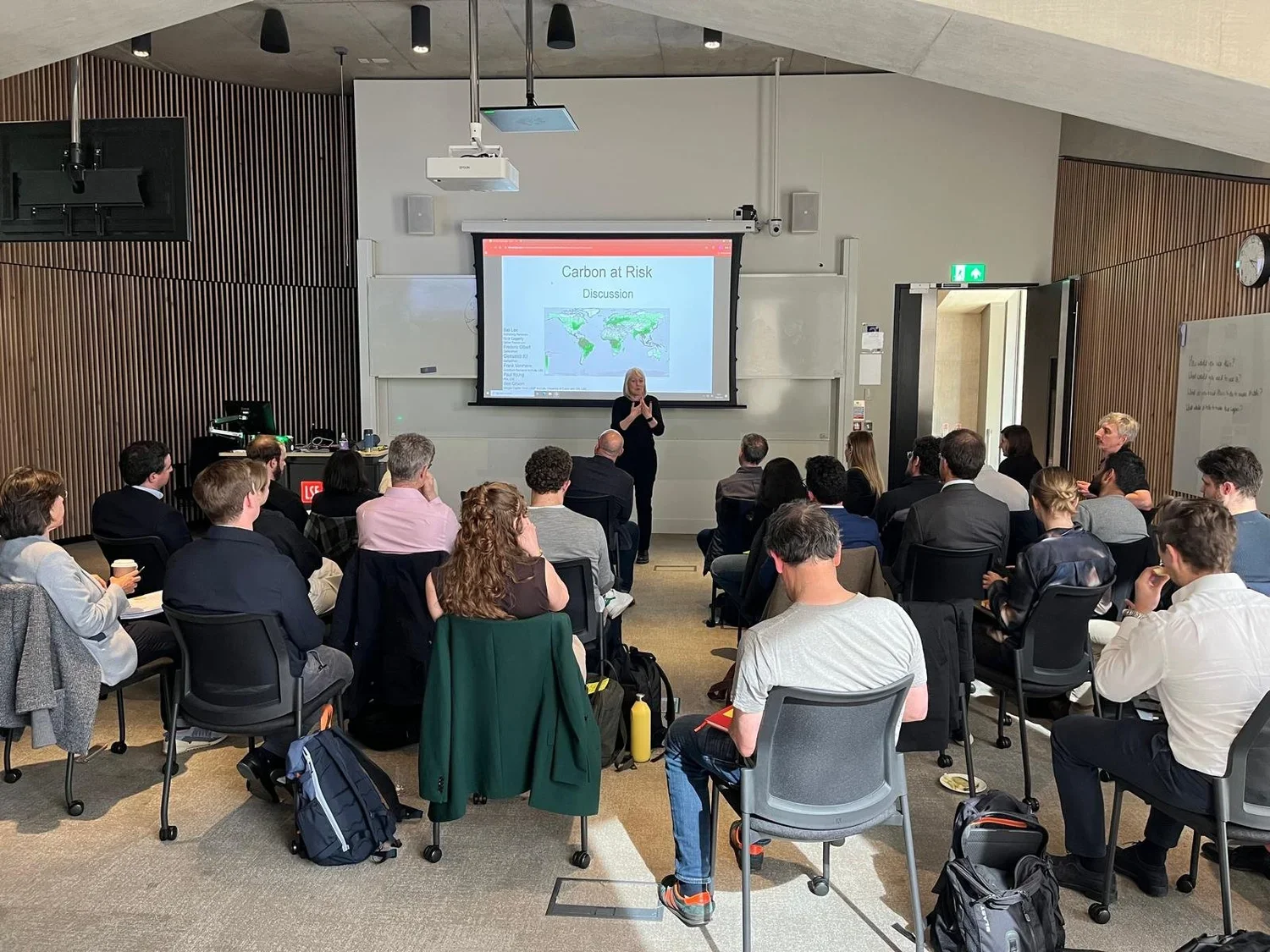
Our approach is grounded in ongoing academic research
The CaR Framework
Inspired by Value at Risk in financial markets, Carbon at Risk (CaR) models how carbon storage outcomes evolve over time across climate relevant timescales.
Rather than a single average estimate, it captures how risks unfold across time, revealing maximum expected losses, when they might occur, and how they collide.
This enables meaningful comparison across pathways, from reforestation to direct air capture, supporting better risk management, pricing and forward planning.

How does the storage security change over time? What are the best and worst case scenarios, how likely are they to occur and what is the best way to manage them?
01 Storage Risk Evaluation

Do risks move together or separately? How does the global portfolio respond to different climate shocks. How can we track changes in total carbon stocks over time?
02 Correlation Analysis

Can tail risks be diversified away? What are the trade-offs between risk, cost, and storage security? What would an optimal portfolio look like?
03 Portfolio builder
ABOUT US
We are building an open methodology that benefits from shared insight, critique and contribution.